

What is the ideal balance between freedom of information and privacy? That’s ultimately the question recording laws try to answer. Whether a person’s rights were violated after being recorded is often hotly debated in legal cases and the results can have profound implications on both private and professional lives. Here’s what you need to know about the legality of recording in Oklahoma.
Is It Legal to Record a Conversation In Oklahoma?
Per Oklahoma recording laws, it is legal to record a conversation if the recorder follows the one-party consent rule, is part of the conversation, and there is no reasonable expectation of privacy.
What Is One-Party Consent?
One-party, or single-party, consent means that it is legal to record a conversation if one participant agrees to the recording. In other words, if one person wants to record a conversation they are part of, they can do so without notifying or getting permission from the other person (or people) involved. This rule applies to both in-person and electronic communications. To summarize, Oklahoma recording laws state:
- Only one person involved in the conversation needs to consent to recording
- The person who consents can also be the one doing the recording (so, you can be recorded without your knowledge or agreement)
- The recorder must be a participant in the conversation
- The legal definition of a “conversation” includes:
- Electronic communications (telephone calls, email and text messages, video calls, etc.)
- In-person discussions
Note that these laws vary by state—while Oklahoma abides by a one-party consent rule, other states have two-party or all-party consent laws, where all participants must agree to the recording. There are a lot of different technologies and apps available to make recordings for public protection or otherwise, so be sure you know the laws in whatever state you’re in.
Exceptions to Oklahoma Recording Laws
The general rule is that only one party needs to consent to the recording of a conversation and the recorder must be part of the conversation. But there are specific circumstances and locations where recording might be restricted or prohibited, regardless of consent:
- Illegal Purposes: You cannot record a conversation if you intend to use the recording to commit a crime or for any illegal purpose, such as blackmail, harassment, or exploitation of minors.
- Expectation of Privacy: Recording is prohibited in situations where individuals have a reasonable expectation of privacy and have not consented to being recorded. This could include places like bathrooms, changing rooms, or private homes where the recorder is not part of the conversation.
- Safety: When the conversation involves a threat to a person’s safety or security, recording is illegal.
- Confidential Settings: Specific regulations may prohibit recording in settings like courtrooms or private business meetings without explicit permission from the presiding authority or all parties involved.
- Federal Laws: Federal law has its own set of exceptions and interpretations. Consent may not be required if the recording is made by law enforcement officials as part of an investigation or pursuant to a court order
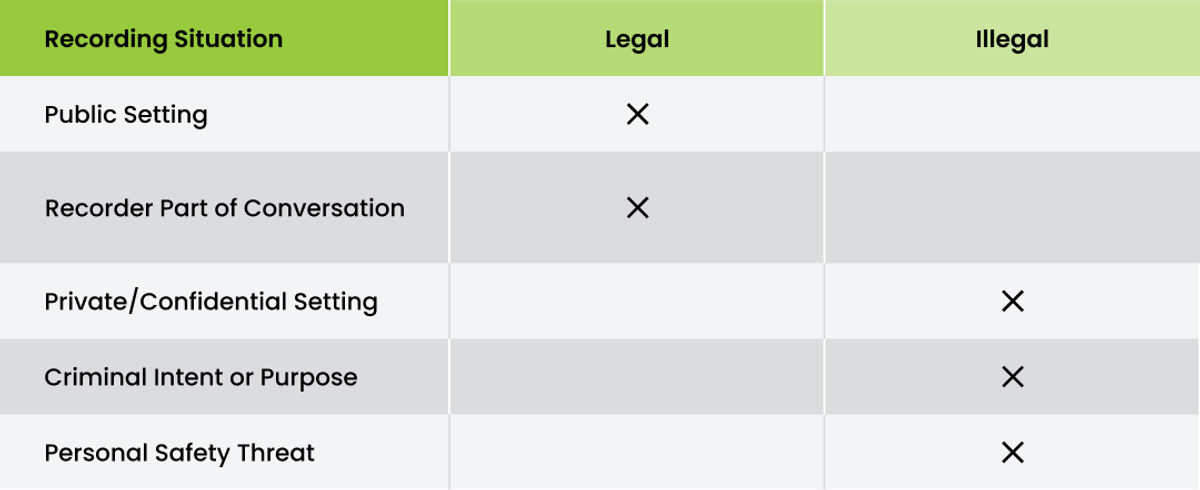
While Oklahoma recording laws are relatively straightforward, it's important to be aware of these exceptions and understand the contexts in which recording might lead to legal issues or infringe on privacy rights.
Oklahoma Recording Laws: Audio vs. Video
The laws regarding audio and video recording are essentially the same, but there are more legal sensitivities surrounding the privacy expectations and the contexts in which video recordings can be made. Quite simply, because videos reveal visual details about people and places, the privacy considerations are more complex.
In any case, while one-party consent applies to audio recordings, the context and method of video recording can introduce additional legal requirements or restrictions.
What Are the Consequences of Illegal Recording?
Per Okla. Stat. tit. 13, § 176.3, illegally recording a conversation is a felony offense punishable by a fine of $5,000.00, or imprisonment of up to 5 years, or both. Disclosing the contents of a conversation obtained through illegal recording is also felony and would qualify as a criminal case.
Oklahoma’s Eavesdropping Law
Eavesdropping is the act of secretly listening to the private conversations of others without their consent. In this scenario, the listener is not part of the conversation and is typically using some type of device to overhear, record, amplify, or transmit what’s being said.
Eavesdropping laws overlap with Oklahoma’s recording laws in most ways. It is illegal to eavesdrop and record the conversation if:
- You do not have one-party consent
- You are not part of the conversation
- The participants have a reasonable expectation of privacy
Similar to the recording laws, there are exceptions to the legality of eavesdropping, such as when law enforcement officers have a warrant and are carrying out their duties.
Engaging in illegal eavesdropping can lead to both criminal prosecution and civil lawsuits that could result in fines, imprisonment, and damages.
The Final Word
While Oklahoma's one-party consent law does allow for considerable freedom in recording conversations if you are a participant, it generally prohibits recordings where you do not have consent from at least one person or are eavesdropping and not a participant.
If you recorded a conversation, or have been recorded, and are unsure if it’s legal, we can help. Our attorneys have decades of experience handling criminal cases and know Oklahoma’s recording laws inside and out. Contact us for a free case evaluation.